
You're doing an inbound strategy, but your business is still struggling with leads slipping through the cracks, mixed-up messages, and sales teams left scratching their heads.
You're thinking of going back to the outbound approach, but you know it doesn't go well with modern buyers' journey and mindset.
You might just be missing something. In this article, we'll discuss what an inbound strategy is and how inbound marketing and sales processes can be combined to build B2B growth, level up business, and convert more customers to promoters.
Key Takeaways
- Inbound strategy attracts customers through tailored content and customer journey mapping, prioritising value over interruptive tactics.
- It is more aligned with modern buyers' mindset than outbound strategies pushing messages to their targeted audiences.
- Inbound marketing follows three stages: Attract (draw in prospects), Engage (convert to customers), and Delight (create advocates).
- Inbound sales follows five stages: Discovery, Diagnostic, Design, Delivery, and Display, focusing on understanding prospects before presenting solutions.
- The inbound journey framework integrates both approaches: Attract + Discover, Engage + Diagnose-Design, and Delight + Deliver-Display.
- Smarketing (sales and marketing alignment) can
- deliver up to 208% more revenue growth when teams collaborate effectively.
- Successful alignment requires shared goals, service level agreements, joint content creation, and unified customer data management.
Understanding the Inbound Strategy
An inbound strategy is a methodology for businesses that attracts and nurtures prospects through tailored content and customer journey mapping instead of interruptive tactics, which we have seen for decades.
It works by aligning marketing and sales teams, using customer journey mapping to attract ideal prospects with SEO-rich content, engaging them with tailored resources via content management systems, and delighting them to spark advocacy.
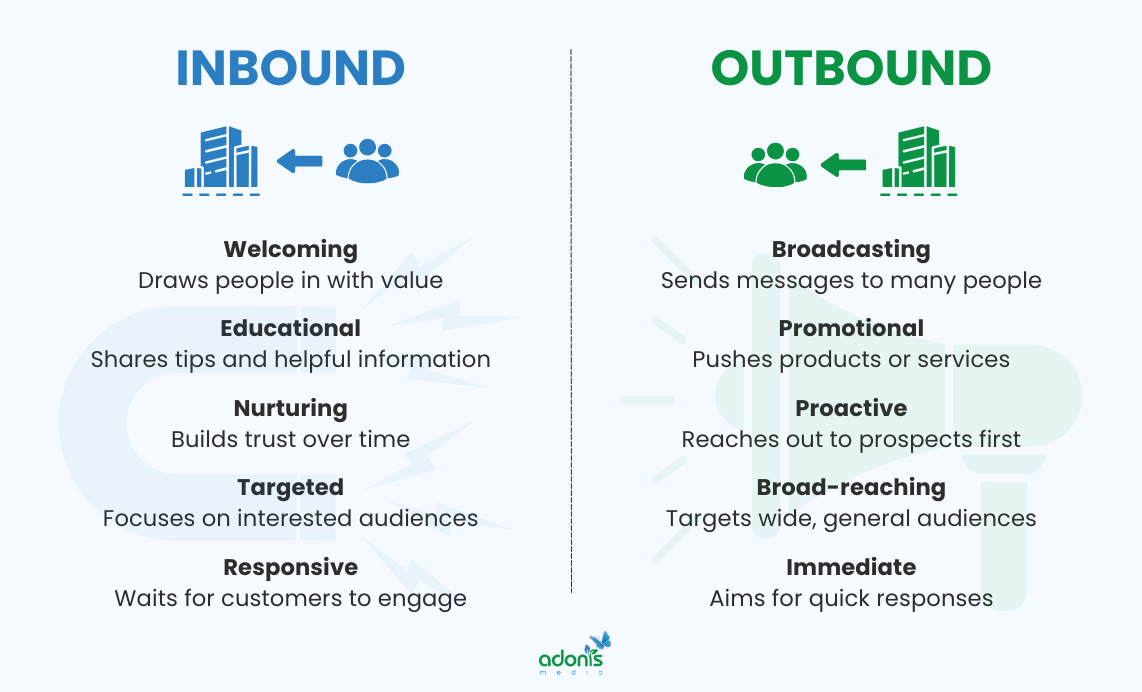
Unlike outbound strategies that push messages to their targeted audiences, inbound earns attention rather than buying it, which is more aligned with the modern buyers' mindset, where they are researching solutions first before making decisions.
In B2C marketing, inbound strategy uses content management systems to publish engaging blogs, videos, and social updates to organise them and sales enablement tools for lead nurturing and sales process.
It is the same with B2B marketing. However, the slight distinction is that it drives lead generation through in-depth whitepapers, case studies, and webinars that address buyer pain points.
Since B2B purchases involve multiple decision-makers and longer sales cycles, your content must address various concerns at different journey stages.
Integrating customer journey mapping and content management systems ensures every B2B touchpoint is personalised, helping marketing and sales teams align on messaging and deliver consistent experiences.
Inbound marketing and inbound sales form the two pillars of a successful inbound strategy, with smarketing ensuring seamless inbound marketing and sales integration at every customer journey stage.
What Is Inbound Marketing?
Inbound marketing attracts customers to your brand through valuable content and experiences tailored to their needs.
Unlike outbound marketing, which broadcasts messages to large audiences regardless of their interest, inbound marketing focuses on being found by people who are already searching for answers to their questions, problems, or frustrations.
It delivers better results because you're reaching people who are already looking for solutions you provide. The leads are warmer, and conversion rates are typically higher.
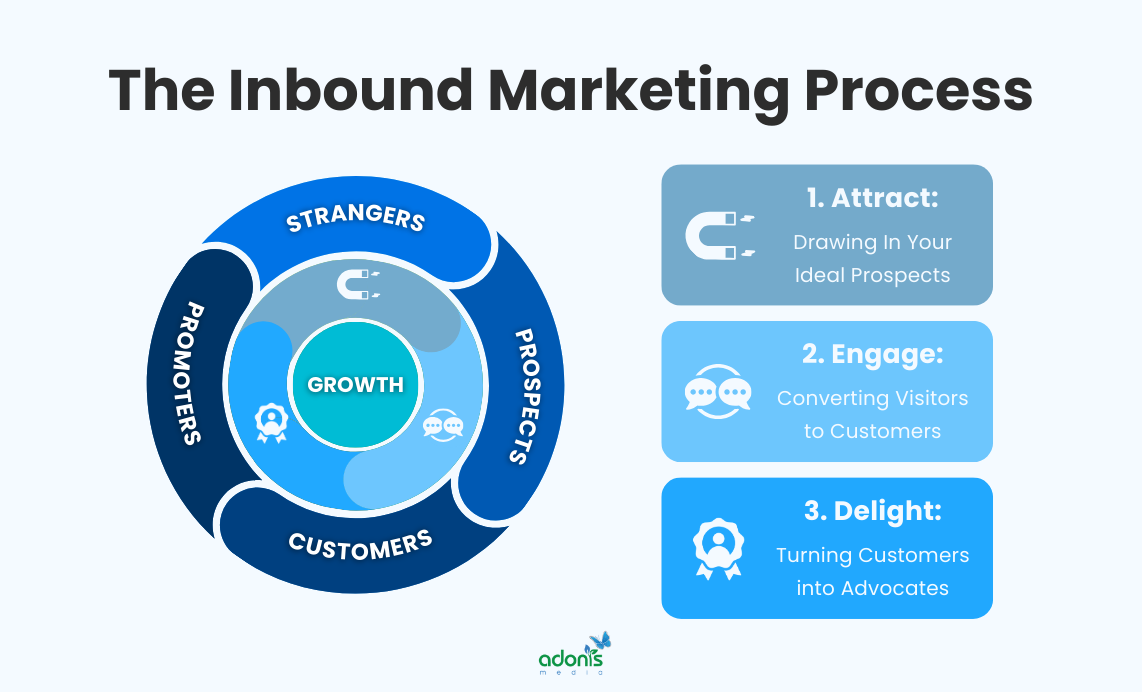
The inbound marketing process has three main stages: Attract, Engage, and Delight. Each stage relies on one another and doesn't go from top to bottom, it's more of a flywheel concept.
1. Attract: Drawing In Your Ideal Prospects
In this stage, you attract visitors to your website or social media pages by creating content that addresses their specific problems and questions.
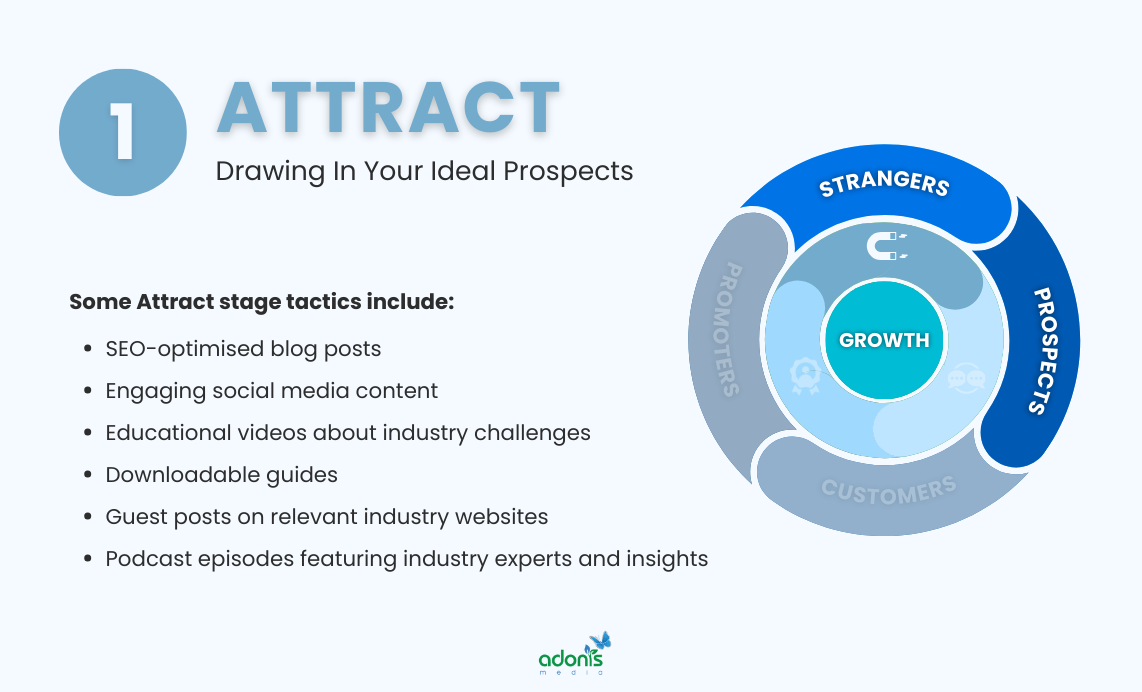
The goal here is to convert those strangers and visitors into your prospects or leads by appearing in the right places with the right content at the right time.
This stage includes developing buyer personas, conducting keyword research, and creating various content formats that address early-stage questions. Content management systems help organise and optimise these assets for maximum visibility.
Implementing strong attract tactics builds brand awareness and establishes your expertise without pushing sales messages too early. It's always about becoming a trusted resource first.
Some Attract stage tactics include:
- SEO-optimised blog posts
- Engaging social media content
- Educational videos about industry challenges
- Downloadable guides
- Guest posts on relevant industry websites
- Podcast episodes featuring industry experts and insights
2. Engage: Converting Visitors to Customers
This stage focuses on building relationships with prospects through meaningful interactions to address their needs and pain points.
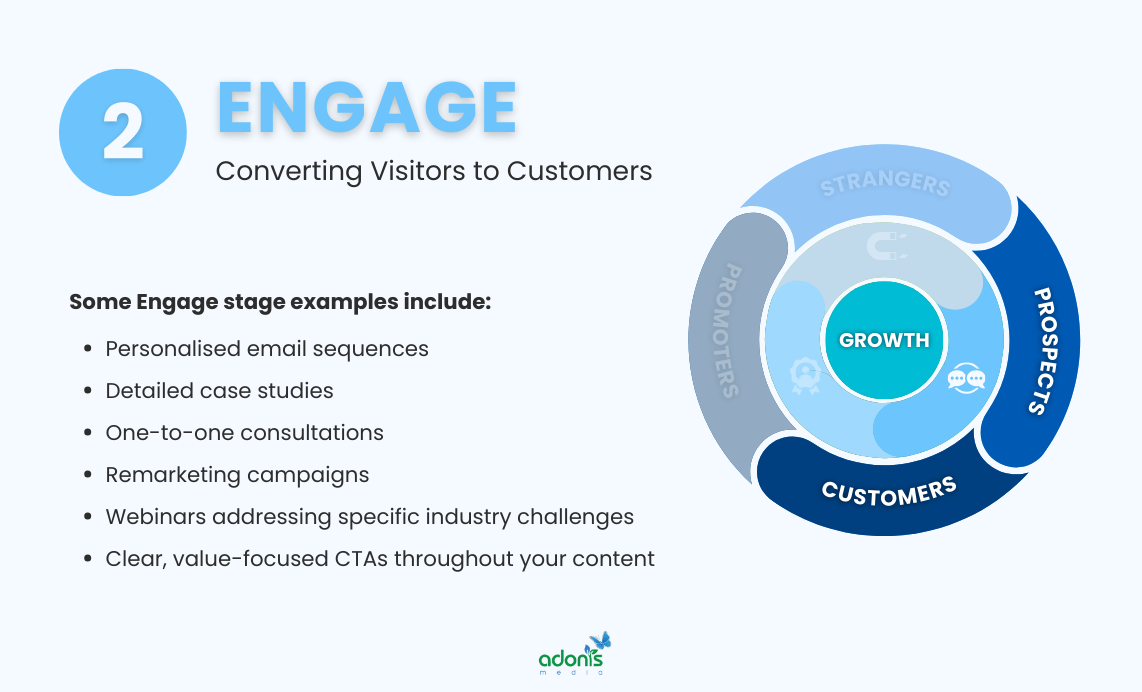
The goal here is to convert those leads and prospects into your customers by showing them how your solutions solve their unique challenges.
From building trust through content, you now build trust through personalised communication and valuable information exchange.
This stage includes lead nurturing through targeted content, personalised emails, and timely responses to inquiries. You can also implement marketing automation while maintaining authentic connections through each touchpoint in the customer's journey.
When done properly, engagement creates educated prospects who understand your value proposition and are ready to make informed purchasing decisions.
Some Engage stage examples include:
- Personalised email sequences
- Detailed case studies
- One-to-one consultations
- Remarketing campaigns
- Webinars addressing specific industry challenges
- Clear, value-focused CTAs throughout your content
3. Delight: Turning Customers into Advocates
The inbound methodology doesn't end with a sale, it continues by nurturing ongoing relationships.
This stage is about exceeding customer expectations after their first purchase to create long-term loyalty and turn them into vocal brand champions.
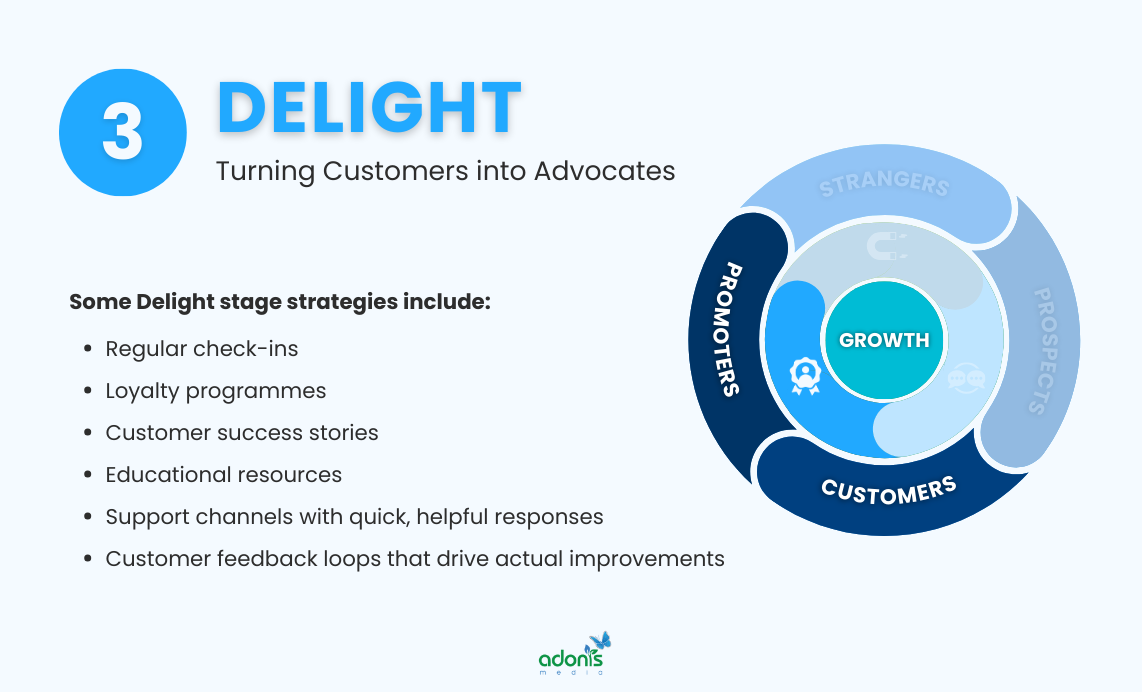
The goal here is to delight current customers, make them become promoters, and sustain them for a very long time. This happens through them sharing their positive experiences and sharing your business through word of mouth, social media, and other outlets or channels they use.
From trusting your content and personalised communication, they now trust your brand fully as you sustain their loyalty through different means.
Successfully delighting customers reduces churn and increases lifetime value. Your best marketers become your existing customer base.
Some Delight stage strategies include:
- Regular check-ins
- Loyalty programmes
- Customer success stories
- Educational resources
- Support channels with quick, helpful responses
- Customer feedback loops that drive actual improvements
What Is Inbound Sales?
While inbound marketing attracts and nurtures potential customers, inbound sales guides them through a decision process that feels natural.
Inbound sales is a customer-focused sales approach that prioritises understanding potential buyers' needs, challenges, and goals. When sales teams understand what customers need, conversion rates and customer satisfaction naturally improve.
It is the natural continuation of the visitors' journey from being attracted to your content. Once they find the value of what they've read, watched, or downloaded, they might explore more of what you offer, ending with them connecting to your business instead of you doing the first move.
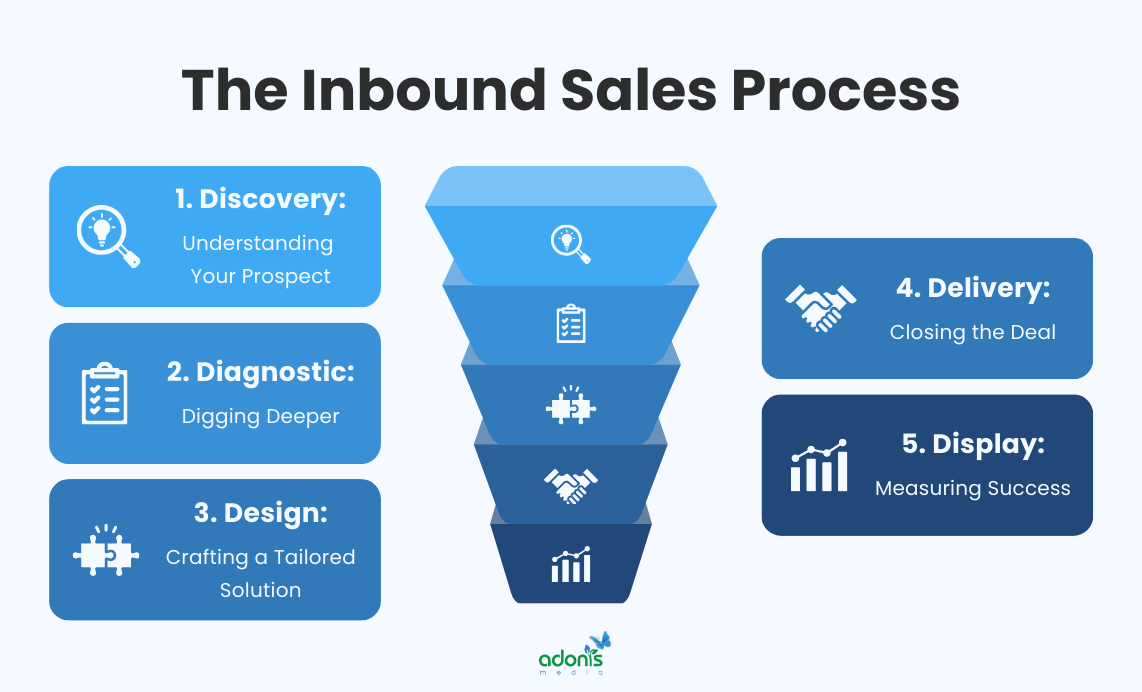
The inbound sales process has five main stages — Discovery, Diagnostic, Design, Delivery, and Display.
1. Discovery: Understanding Your Prospect
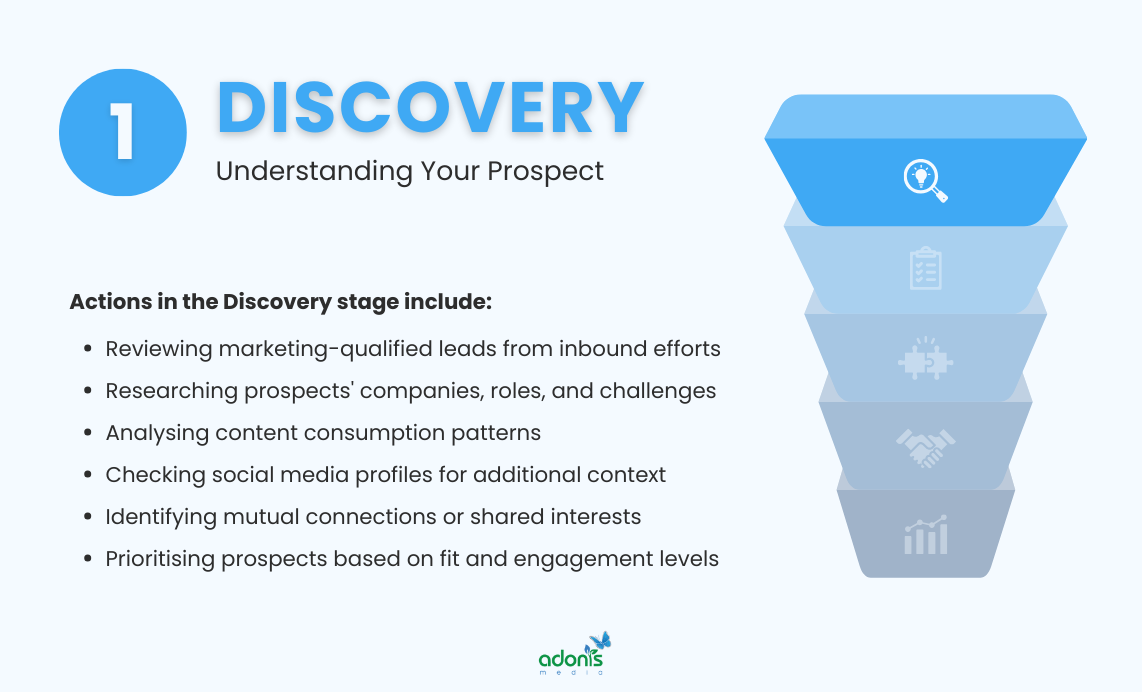
In this stage, salespeople identify and research potential customers who have already shown interest in solving problems your product addresses.
This includes reviewing website interactions, content downloads, and other engagement signals to understand prospect needs. Salespeople analyse this data alongside company information to prepare for meaningful conversations.
Actions in the Discovery stage include:
- Reviewing marketing-qualified leads from inbound efforts
- Researching prospects' companies, roles, and challenges
- Analysing content consumption patterns
- Checking social media profiles for additional context
- Identifying mutual connections or shared interests
- Prioritising prospects based on fit and engagement levels
2. Diagnostic: Digging Deeper
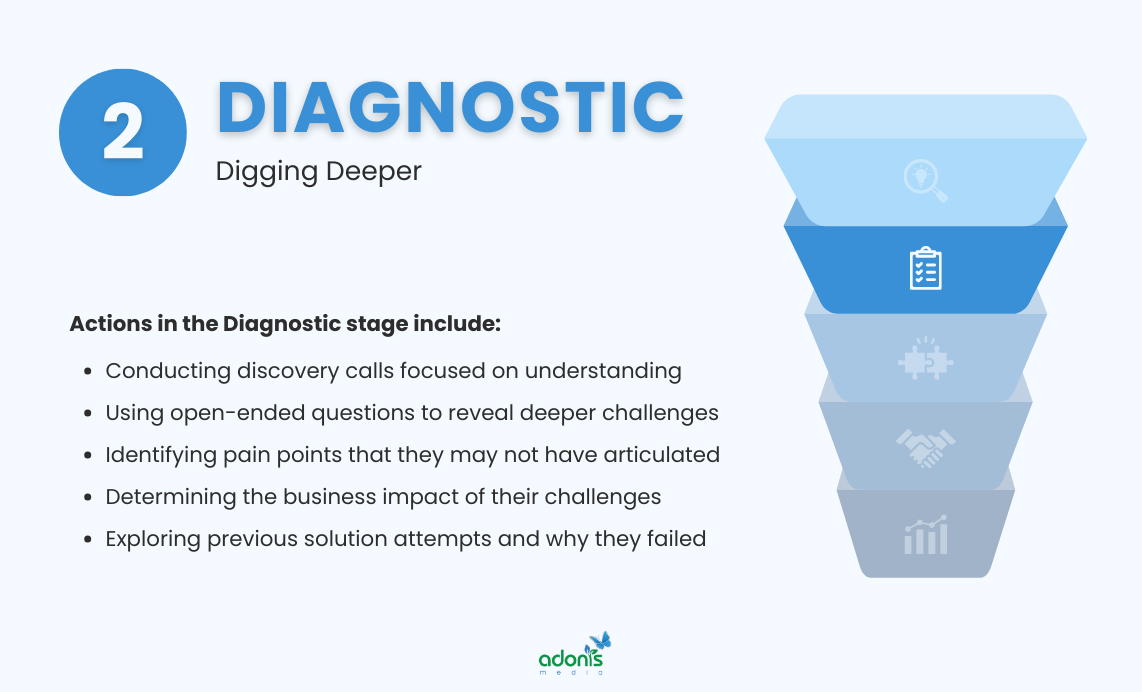
This stage moves beyond initial research to truly understand the prospect's specific challenges through active conversation and thoughtful questioning.
During this stage, salespeople ask targeted questions that reveal the real problems behind the symptoms, listening more than talking, seeking to understand both stated and unstated needs through exploratory conversations and careful analysis.
Actions in the Diagnostic stage include:
- Conducting discovery calls focused on understanding
- Using open-ended questions to reveal deeper challenges
- Identifying pain points that they may not have articulated
- Determining the business impact of their challenges
- Exploring previous solution attempts and why they failed
3. Design: Crafting a Tailored Solution
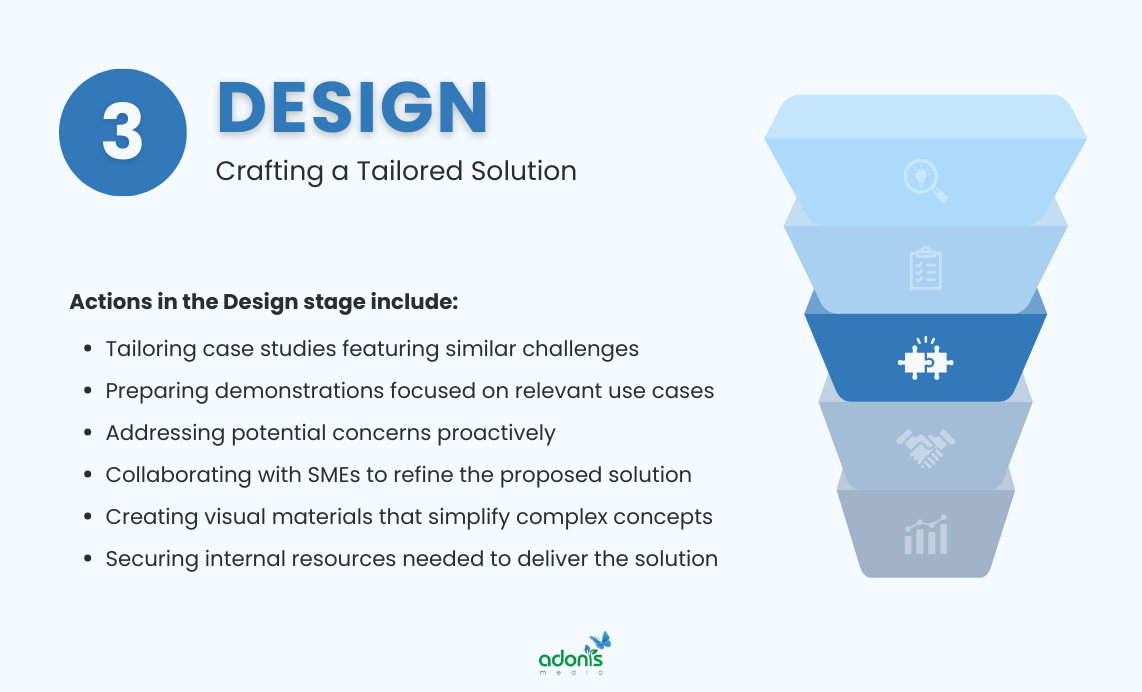
This stage is where inbound salespeople develop customised solutions based on the specific insights gathered during diagnosis.
This includes mapping product capabilities directly to customer needs, creating personalised presentations, and developing proposals that speak directly to identified challenges. The focus remains on the prospect's goals rather than on product features.
Every solution should feel explicitly built for that customer. Customers feel understood and confident that you've designed a solution with their specific situation in mind, not a one-size-fits-all offering.
Actions in the Design stage include:
- Tailoring case studies featuring similar challenges
- Preparing demonstrations focused on relevant use cases
- Addressing potential concerns proactively
- Collaborating with SMEs to refine the proposed solution
- Creating visual materials that simplify complex concepts
- Securing internal resources needed to deliver the solution
4. Delivery: Closing the Deal
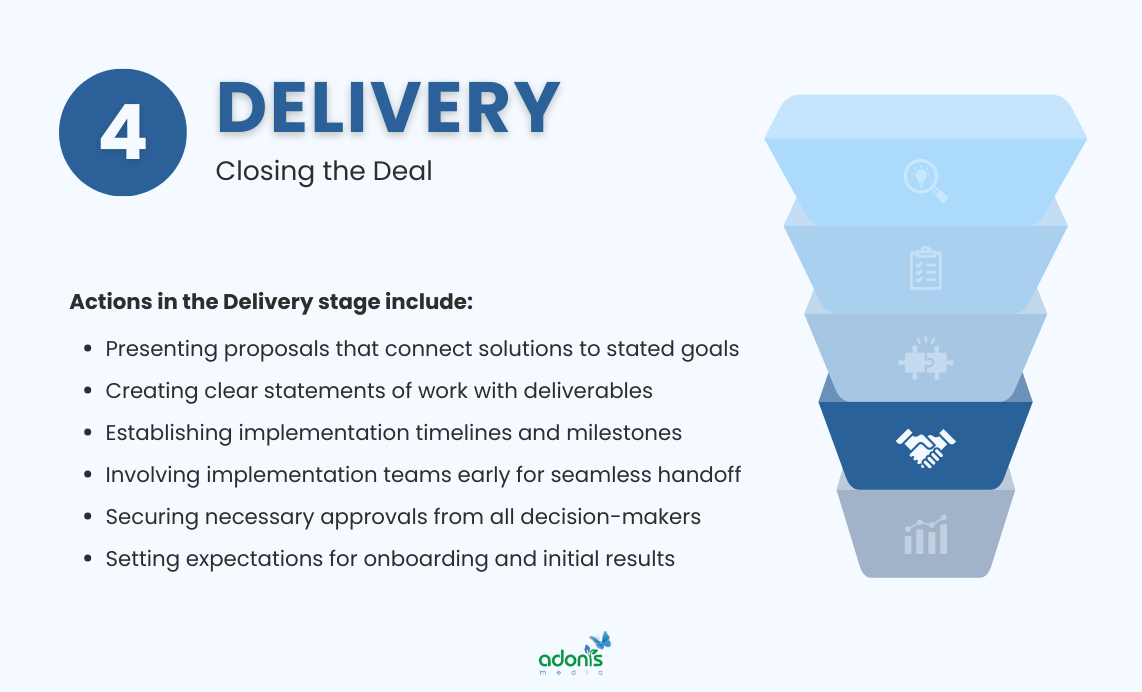
This stage is where all previous work culminates in a decision. It's about presenting your solution confidently while addressing any remaining concerns or objections.
Salespeople guide prospects through final decision-making processes, create clear proposals with transparent terms, and establish implementation timelines.
Proper delivery ensures prospects feel confident in their decision rather than uncertain or pressured. It sets the foundation for a successful implementation and long-term relationship built on trust and clear expectations.
Actions in the Delivery stage include:
- Presenting proposals that directly connect solutions to stated goals
- Creating clear statements of work with deliverables
- Establishing implementation timelines and milestones
- Involving implementation teams early for seamless handoff
- Securing necessary approvals from all decision-makers
- Setting expectations for onboarding and initial results
5. Display: Measuring Success
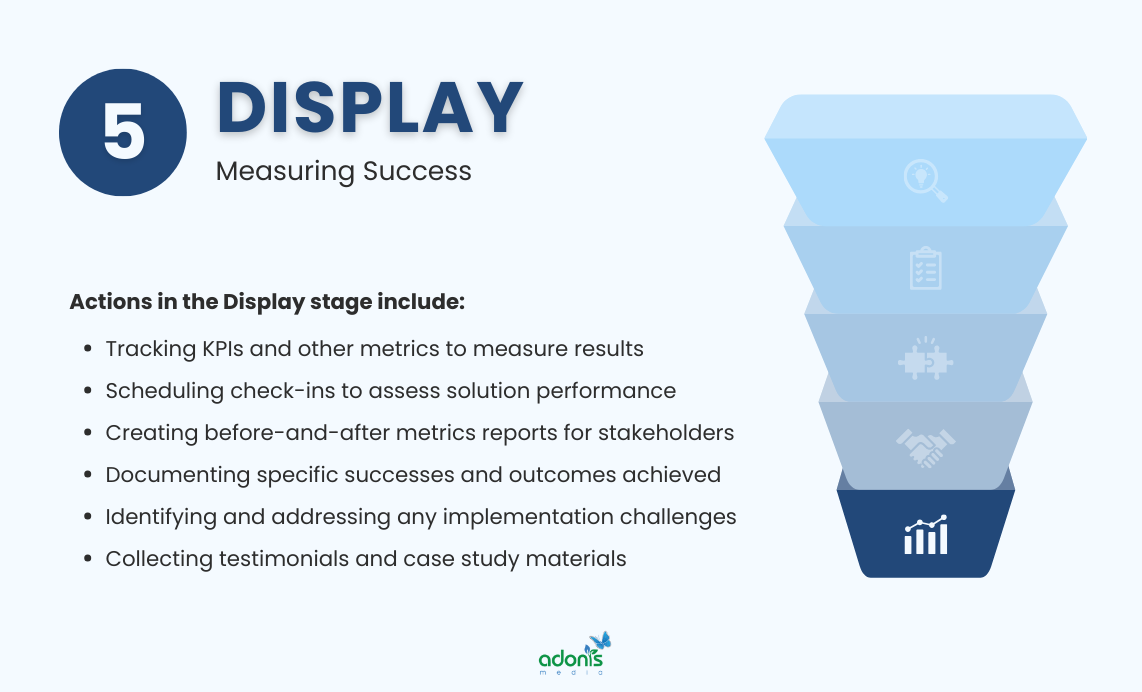
This stage focuses on measuring, documenting, and showcasing the success of the solution after implementation. It's evidence that inbound sales delivers real results.
This includes tracking key performance indicators, collecting customer feedback, and documenting success stories. You may work closely with customers as well to quantify improvements and identify additional opportunities for growth or optimisation.
Satisfied customers generate powerful social proof for prospects. It completes the inbound sales process by turning successful customers into advocates who fuel your inbound marketing efforts.
Actions in the Display stage include:
- Tracking KPIs and other metrics to measure results and optimise
- Scheduling regular check-ins to assess solution performance
- Creating before-and-after metrics reports for stakeholders
- Documenting specific successes and outcomes achieved
- Identifying and addressing any implementation challenges
- Collecting testimonials and case study materials
The Inbound Journey Framework
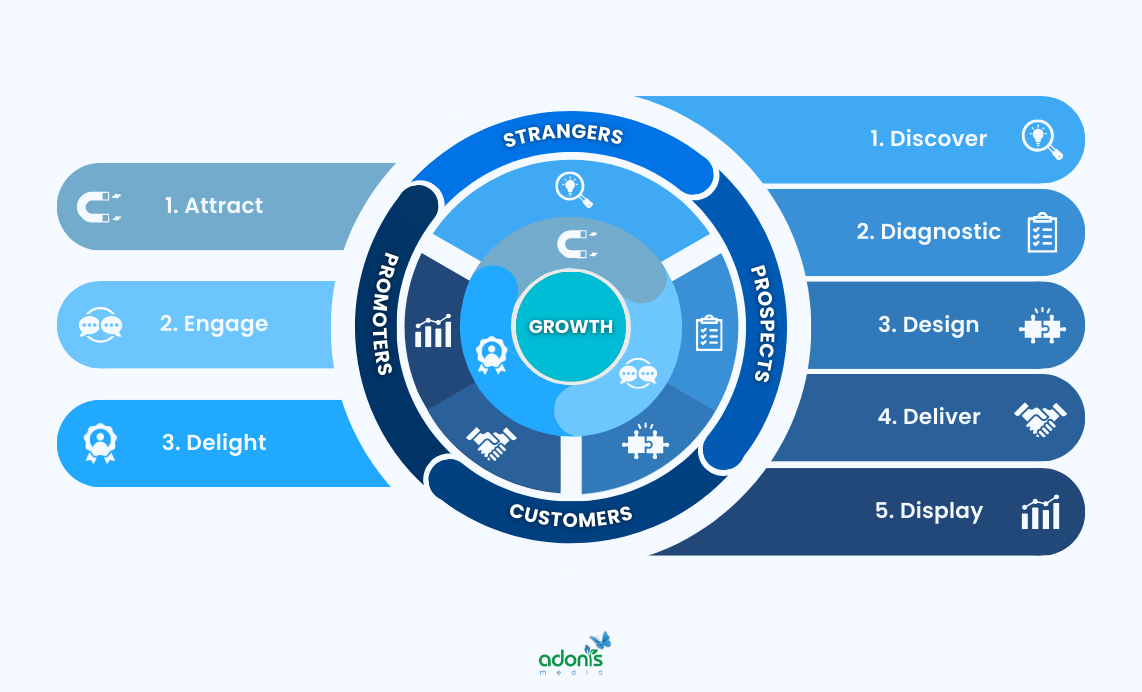
You now know what inbound marketing and sales are, but the main point of this article is for you to understand how both processes work together for your inbound strategy.
The inbound journey framework works as a flywheel, not a funnel, and the inbound marketing process is the focused part, wherein inbound sales stages are divided.
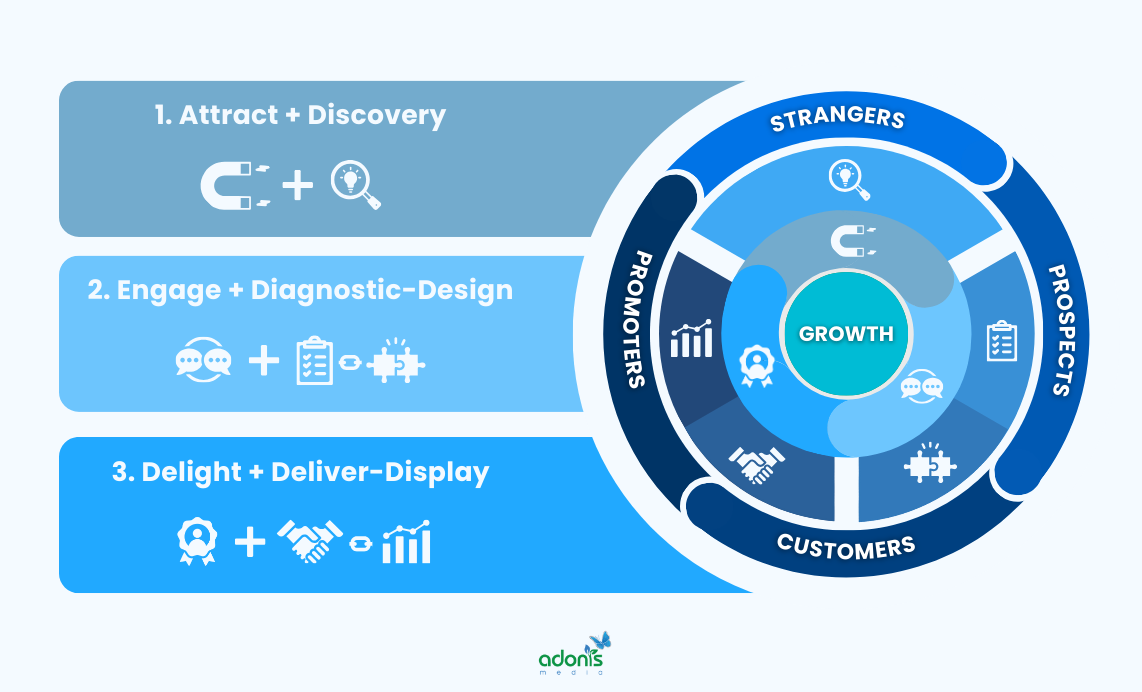
The framework has three main stages: Attract + Discover, Engage + Diagnose-Design, and Delight + Deliver-Display. It's literally adding both processes and combining stages based on their relevance to each other.
Each stage retains its purpose and definition, whether combined or separate, but it's important to clarify how your marketing and sales teams will collaborate to navigate them effectively.
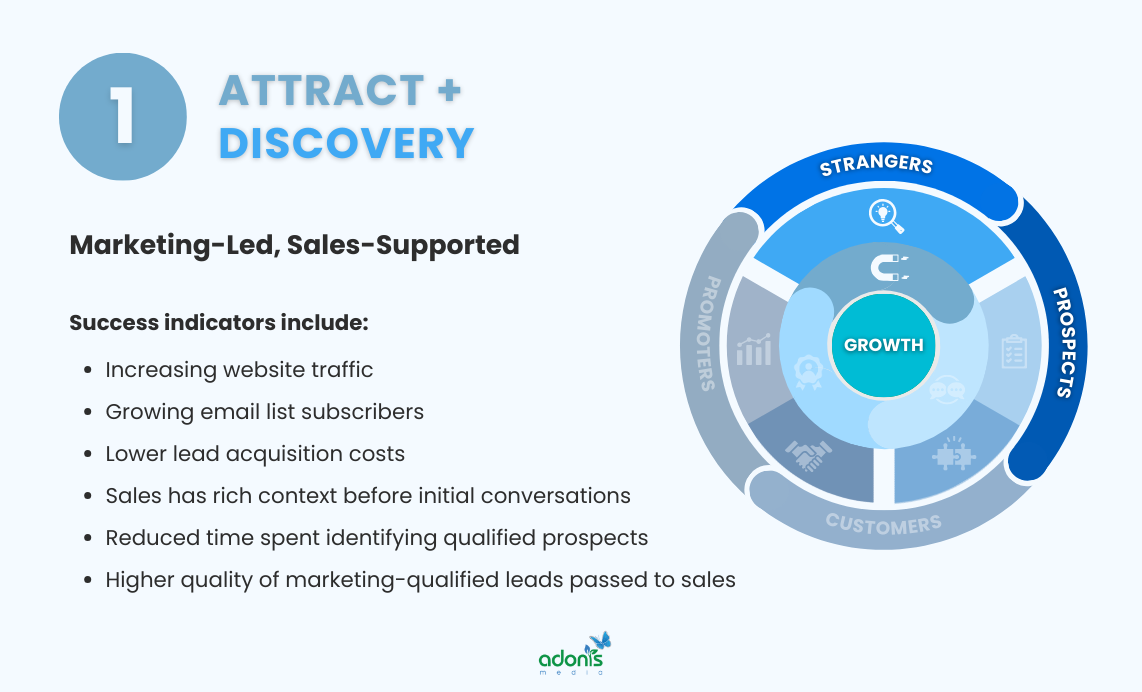
1. Attract + Discover
In this stage, marketing takes the lead while sales plays a supporting role. Marketing creates valuable content that draws in potential customers, while sales monitors these interactions to identify promising prospects.
Marketing teams focus on creating blog posts, videos, social media content, and downloadable resources that address common customer questions and challenges. They optimise this content for search engines and promote it across relevant channels to increase visibility.
Meanwhile, sales teams review incoming leads, research prospects engaging with content, and prepare for meaningful conversations. They analyse which content pieces prospects have consumed to understand their specific interests and potential pain points.
The handoff occurs when a prospect shows sufficient engagement signals, such as downloading multiple resources or visiting high-intent pages. At this point, marketing passes qualified leads to sales with context about their previous interactions.
Success indicators include:
- Increasing website traffic
- Growing email list subscribers
- Lower lead acquisition costs
- Sales has rich context before initial conversations
- Reduced time spent identifying qualified prospects
- Higher quality of marketing-qualified leads passed to sales
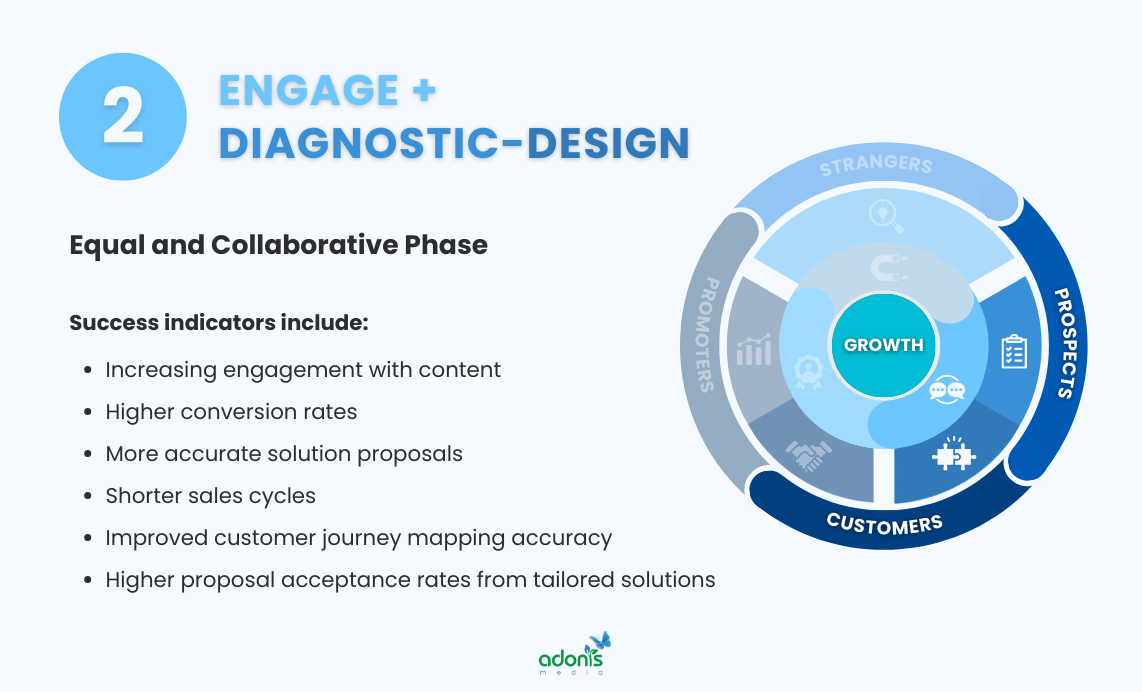
2. Engage + Diagnose-Design
During this middle stage, marketing continues nurturing leads with targeted content while sales actively explores specific challenges and begins crafting solutions. Both teams coordinate closely to move prospects toward an informed decision.
Marketing teams develop content tailored to specific buyer journey stages, implement automated email sequences, and host educational webinars. They create case studies and comparison tools that address the specific challenges prospects have begun sharing with the sales team.
Salespeople conduct discovery calls focused on understanding rather than pitching, ask thoughtful questions to uncover deeper needs, and begin mapping product capabilities to specific customer challenges. They collaborate with subject matter experts to design customised solutions.
Marketing and sales collaborate most intensely at this stage, with marketing creating late-stage decision content that sales can personalise.
Success indicators include:
- Increasing engagement with content
- Higher conversion rates
- More accurate solution proposals
- Shorter sales cycles
- Improved customer journey mapping accuracy
- Higher proposal acceptance rates from tailored solutions
3. Delight + Deliver-Display
In this final stage, sales leads the process of closing deals and ensuring implementation success, while marketing provides supportive materials that reinforce the purchase decision and highlight customer achievements after implementation.
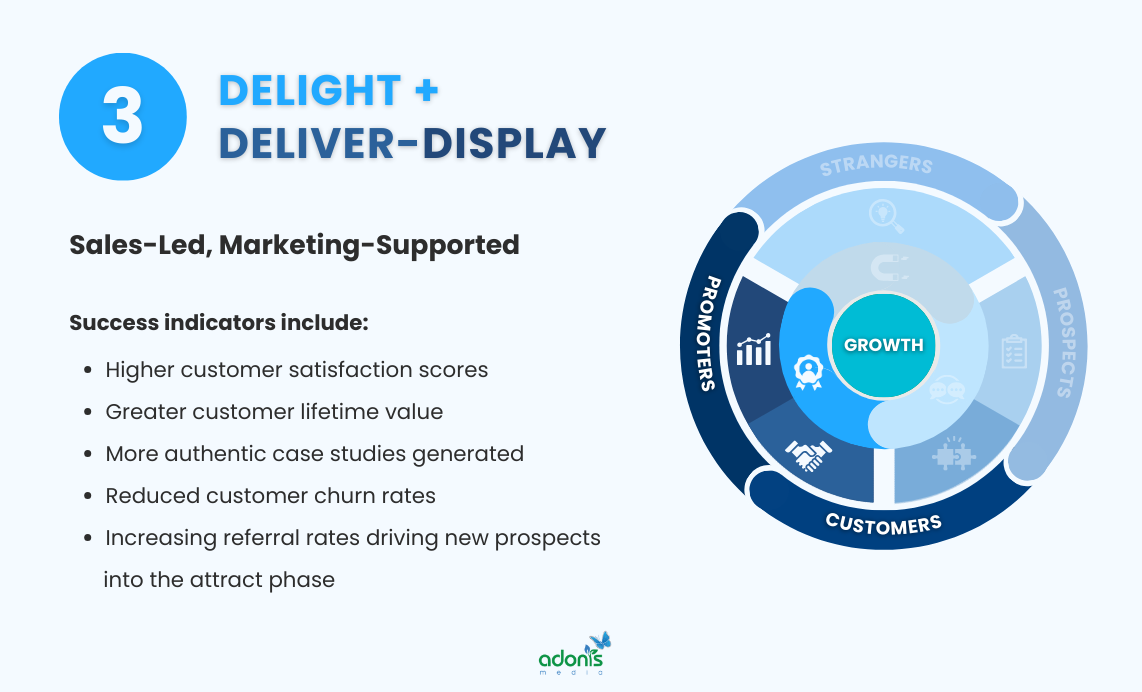
Salespeople finalise agreements with clear terms, establish implementation timelines, measure solution effectiveness, collect performance data, and identify expansion opportunities. They ensure customers experience the full value promised during the sales process.
Marketing creates onboarding resources, develops customer communities, implements feedback mechanisms, and maintains regular communication through newsletters and exclusive content. They transform customer successes into compelling stories that feed back into the attract stage.
The teams collaborate to turn successful implementations into case studies, with sales providing real metrics and testimonials while marketing crafts compelling narratives. Inbound marketing and sales integration reaches its pinnacle when new prospects discover your brand through existing customer advocacy.
Success indicators include:
- Higher customer satisfaction scores
- Greater customer lifetime value
- More authentic case studies generated
- Reduced customer churn rates
- Increasing referral rates driving new prospects into the attract stage
Smarketing: Your Key to the Inbound Journey
Smarketing is the strategic fusion of sales and marketing departments, creating a unified workflow that directly impacts revenue growth. It breaks down traditional barriers that have historically kept these teams apart.
The most brilliant inbound marketing and inbound sales strategies fall flat when teams work in silos.
Even traditional outbound strategies require strong alignment between departments. When sales and marketing operate as separate entities, leads fall through the cracks, messaging becomes inconsistent, and conversion rates suffer.
On a lighter note, businesses with strong smarketing practices experience up to 208% more revenue growth from their marketing efforts when both teams work as one.
Practicing to unite your teams isn't that easy if working in silos has been done for years. That being said, there are some techniques you can actually use to get your transition smooth.
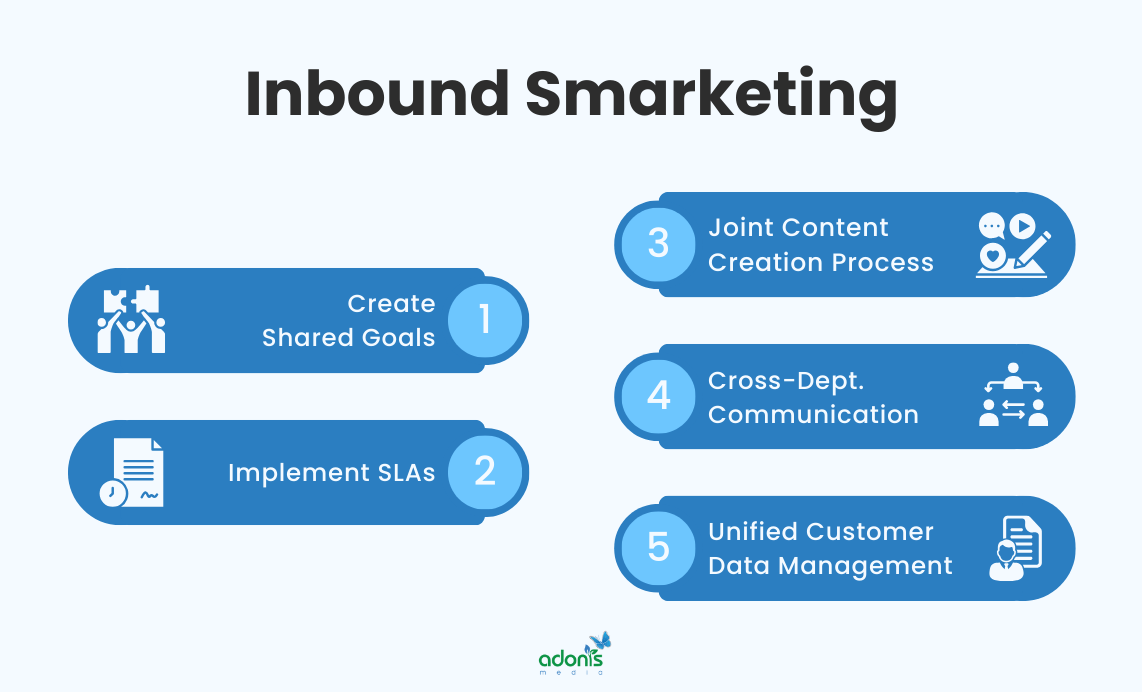
1. Create Shared Goals Between Marketing and Sales
Shared goals give both teams a common destination and remove the temptation to point fingers when challenges arise. It's about unity of purpose.
For the inbound strategy to succeed, marketing and sales must share responsibility for the entire customer journey.
Effective shared goals track metrics that matter to both teams, such as revenue targets, conversion rates, and customer retention. These joint objectives create natural collaboration points and ensure everyone speaks the same language.
Examples of powerful shared goals include:
- Total revenue generated per quarter
- Lead-to-customer conversion rates
- Customer acquisition costs
- Average sales cycle duration
- Customer lifetime value
- Net Promoter Scores
- Content engagement metrics tied to sales outcomes
- Return on marketing investment
You can also schedule quarterly or monthly planning sessions where marketing and sales leaders draft goals together, then communicate these shared objectives to both teams.
2. Implement Service Level Agreements
Service Level Agreements (SLAs) are formal commitments between marketing and sales that define expectations, responsibilities, and accountability measures for both teams.
Within an inbound strategy, SLAs create clear rules of engagement for lead handoffs, response times, and follow-up procedures. They transform vague hopes into concrete agreements about what constitutes a qualified lead and how quickly each team must act.
Review and refine your SLAs quarterly based on actual performance data. The most effective agreements evolve as you gain insights into what works and what doesn't. Static SLAs quickly become outdated as market conditions change.
Make SLAs visible to everyone. Create a simple dashboard showing how both teams are performing against their commitments. It can gradually build trust and help identify bottlenecks before they become serious problems.
3. Joint Content Creation Process
When creating content, involve both marketing and sales teams from the planning stage onwards. Their combined perspectives ensure that content addresses actual customer questions and objections that arise during sales conversations.
Content must serve multiple functions throughout the customer journey. Marketing brings expertise in storytelling and distribution, while sales brings deep knowledge of customer pain points and decision processes.
Salespeople hear objections and questions directly from prospects that marketers may never encounter. This can be an input to their current plan or can be set for new content.
Create a simple system for sales to submit content ideas based on customer interactions. A shared document or Slack channel where sales can drop customer questions becomes a treasure trove of content inspiration for marketing teams.
Consider inviting sales to review content before publication. They'll spot potential misconceptions or missed opportunities that marketers might overlook, which can significantly improve content quality and sales usefulness simultaneously.
4. Cross-Departmental Communication
Regular, open communication between marketing and sales shouldn't be a special occasion. It needs to be done frequently, even daily if needed.
When teams communicate effectively, customer insights don't get trapped in departmental silos. The entire organisation becomes smarter and more responsive as a result.
Create multiple channels for different purposes: weekly stand-ups for tactical discussions, monthly deep-dives for strategic alignment, and real-time digital channels for daily questions. Most importantly, establish a culture where cross-departmental communication is valued and rewarded.
5. Unified Customer Data Management
Unified customer data management creates a single source of truth about prospects and customers that both marketing and sales teams can access, update, and trust.
Without shared data, marketing can't see which content influenced closed deals, and sales lack context about prospect interactions before their first conversation.
Implement a robust CRM system that integrates with your marketing automation platform and content management systems. Ensure both teams receive proper training and establish clear protocols for data entry and maintenance to preserve data quality.
Create dashboards that visualise the customer journey from first touch to closed deal and beyond. This gives both teams visibility into how their efforts contribute to the bigger picture and highlights areas where the handoff might be breaking down.
Further Learning
Looking to learn more? I've collected some fantastic resources that go hand-in-hand with this topic if you want to dive deeper.
- mckinsey.com — Next-gen B2B sales: How three game changers grabbed the opportunity
- hbr.org — 4 Behaviors that Boost Inbound Sales
- hyperise.com — The State Of Cold Outbound Sales: Does It Still Work In 2023?
- infuse.com — Is B2B Outbound Marketing Dead?
- sender.net — 40+ Latest Inbound Marketing Statistics (2025 Report)
- quora.com — Quora Discussion: "Is outbound sales and marketing eventually going to be obsolete?"
- quora.com — Quora Discussion: "In what ways does an inbound approach differ from an outbound approach to digital marketing?"
- reddit.com — Reddit r/sales Thread: "The death of outbound"
Perfect Your Inbound Strategy
Bringing inbound marketing and inbound sales together isn't just smart, it's essential for any business wanting real, sustainable growth.
By embracing the inbound methodology and aligning your teams properly with smarketing, you create a seamless experience for your customers, a more enjoyable workday for your teams, and a great business future.
Ready to see how inbound marketing and sales integration can boost your business? Book a free consultation or contact us today, and let's make your inbound strategy work for you!
Got a question in mind? Check out the FAQs below for quick answers!
