
B2B Digital marketing can feel overwhelming. So many channels, so many tactics, and everything seems urgent and important.
Without a clear framework, most marketers end up with a jumbled mess of disconnected campaigns. Your social posts fight for attention with your emails, your website speaks a different language than your ads, and your analytics look like abstract art.
The result?
Wasted budget and missed opportunities.
That's where the RACE framework comes in. A practical, structured approach that guides B2B marketers through each stage of the customer journey, from first touch to long-term loyalty.
Key Takeaways
- The RACE framework is a digital marketing model that guides brands through the Reach, Act, Convert, and Engage stages of the customer journey.
- Dr. Dave Chaffey and Smart Insights created it to provide a simple, measurable marketing strategy for any business size or industry.
- It starts with the Plan stage, which emphasises digital transformation, target audience, KPIs, and objectives, essentially making it a PRACE framework in some contexts.
- The model starts with a Plan stage, then moves through building awareness, encouraging action, converting leads, and fostering long-term loyalty.
- The framework offers a customer-centric approach that aligns perfectly with modern nonlinear purchase journeys.
- RACE works across all channels — social, email, content, paid ads, etc. — and adapts to both B2B and B2C marketing processes.
- Each stage has clear KPIs and customer acquisition and retention activities, which make the progress easy to track and execute.
- Best practices include setting realistic timeframes, aligning marketing and sales, fixing funnel leaks, and tailoring the approach to your business scale.
- Continuous testing and refinement are essential for using the RACE framework to increase conversions and improve your digital marketing planning.
What Is The RACE Framework?
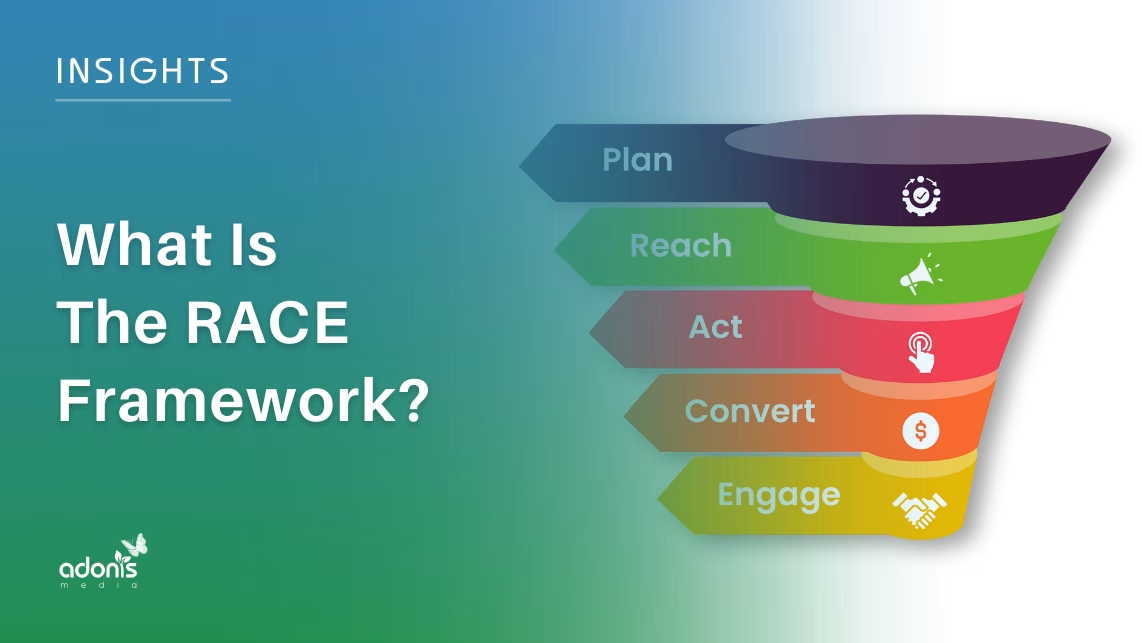
The RACE framework, stands for Reach, Act, Convert, and Engage, is a practical digital marketing model that guides B2B businesses through four customer journey stages.
RACE helps you plot the best route to attract strangers, turn them into visitors, convert them into customers, and keep them returning for more instead of stopping after first purchase.
![The RACE [or PRACE] Framework (Plan, Reach, Act, Convert, Engage)](/storage/images/shared/blogs/in-article-images/race-framework/the-race-framework.webp)
Dr. Dave Chaffey and the team at Smart Insights developed the RACE model in 2010. They created it to give marketers a straightforward structure for planning and implementing digital strategies.
Since its introduction, they have continuously refined the framework, adding a "Plan" stage at the beginning, making it PRACE in some contexts.
Unlike traditional marketing frameworks, RACE specifically addresses digital touchpoints while maintaining a strong focus on measurable results and customer-centric approaches at each stage.
RACE works brilliantly alongside customer journey mapping and pairs perfectly with PR Smith's SOSTAC (Situation, Objectives, Strategy, Tactics, Action, and Control) for comprehensive marketing planning and process optimisation.
For B2B companies, the RACE framework adapts beautifully to longer sales cycles. It helps structure content marketing for awareness, nurture leads through educational content, support sales conversations, and maintain relationships post-purchase through targeted communications.
In the B2C world, RACE guides you to build visibility on social platforms, create engaging shopping experiences, simplify checkout processes, and foster post-purchase loyalty programmes that drive repeat business.
Since the RACE Framework has evolved, this article will include the Plan stage to further explain how it contributes to its success.
Why Use RACE Framework in B2B Digital Marketing?
 Info came from the RACE Framework graphics of Smart Insights.
The RACE framework simplifies the complex world of B2B digital marketing by providing a structured, measurable approach to connect with customers throughout their journey.
It works not just because it's practical, but it is very easy to follow.
Besides, there are many benefits you can see when you implement this in your marketing plan.
Clear Roadmap for B2B Digital Marketing Implementation
The RACE framework offers marketers a straightforward path to follow when planning and executing campaigns. It breaks down the customer journey into basic stages, making it easier to create focused strategies for each phase of interaction.
Implementation isn't as daunting as it might seem. The framework's logical flow makes it accessible for businesses of all sizes, whether you're a solo marketer or part of a large team. The key is starting with clear objectives for each stage.
You can avoid the common pitfall of randomly applying marketing tactics without strategic direction. Each element connects to the next, ensuring your efforts build upon each other rather than existing in isolation.
Action-Oriented Approach to Marketing
RACE goes beyond theory by encouraging specific actions at each customer journey stage. It's designed for real-world application rather than just conceptual understanding.
The framework pushes marketers to define concrete tactics that drive customers from one stage to the next. It helps teams stay focused on activities that directly contribute to business goals.
Versatility Across Marketing Channels and Industries
RACE works across all marketing channels, including social media, email, content marketing, paid advertising, etc. It creates a unified approach regardless of where your audience engages with you.
This versatility makes it particularly valuable in today's multi-channel marketing environment.
The framework's principles apply equally well to different industries and business models. Whether B2B, B2C, services, or products, RACE can be tailored to your specific business needs.
Data-Driven Decision Making
RACE puts metrics at the centre of marketing strategy. It encourages setting and tracking specific KPIs for each stage.
It helps marketers identify what's working and what isn't. With clear metrics for each stage, you can quickly spot opportunities for optimisation and improvement.
The framework's emphasis on measurement aligns perfectly with digital marketing's greatest strength — the ability to track, analyse, and refine.
Alignment with Modern Customer Purchase Journeys
Today's customer journeys aren't linear, they're complex and multifaceted. RACE acknowledges this reality by focusing on the actual stages customers move through rather than imposing an artificial funnel.
The framework helps marketers think from the customer's perspective rather than from an internal business viewpoint. This shift is crucial as consumer behaviour research shows that brand loyalty requires addressing both emotional and functional needs throughout the customer journey.
By mapping marketing activities to genuine customer behaviour patterns, RACE creates more relevant and effective campaigns. It encourages brands to create value at each stage, building relationships that extend beyond the initial purchase.
Key Elements of the RACE Framework
As mentioned earlier, the RACE framework begins with a crucial planning stage, even though it's not represented in the acronym. Many marketers now refer to it as PRACE to acknowledge this essential first step in the marketing process.
Let's break down each element of this practical digital marketing strategy framework to understand how they work together throughout the customer journey.
Plan
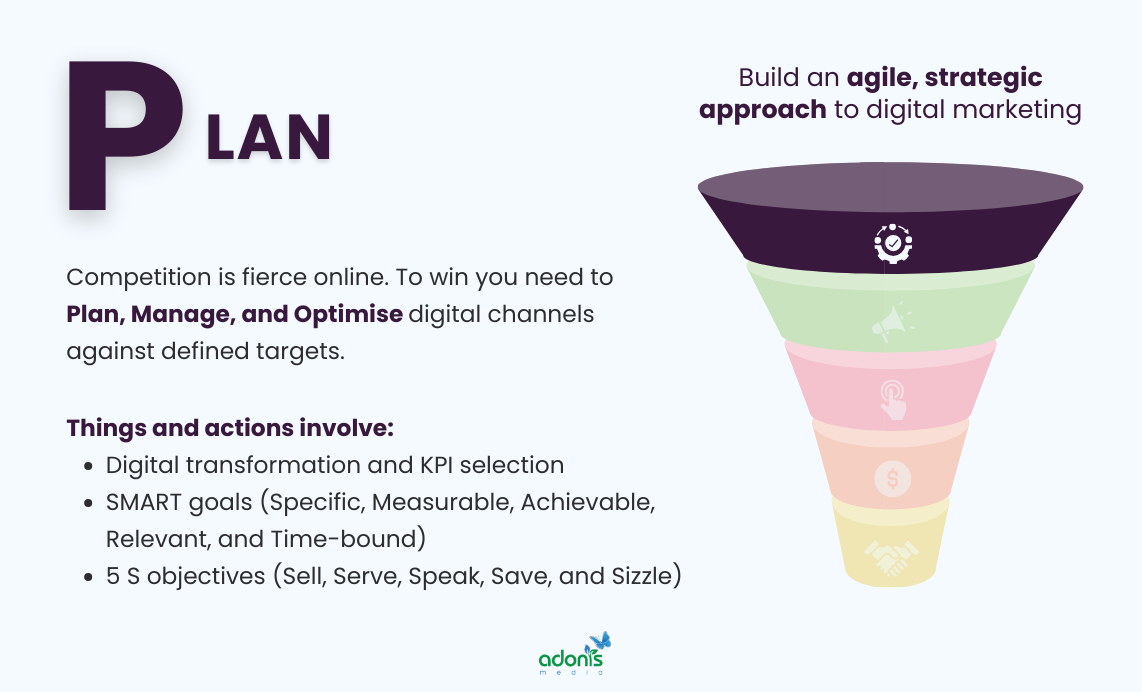
In the Plan stage, you establish your digital marketing strategy before diving into action. It's about setting direction and creating a solid foundation.
 Info came from the RACE Framework graphics of Smart Insights.
The main focus during planning is your digital transformation, selecting appropriate KPIs, and establishing clear objectives. This stage ensures all subsequent marketing activities align with your business goals and that there is a smooth transition between RACE stages.
Digital transformation means evolving your business processes and customer experiences using digital technologies. It's crucial for the Plan stage as it forces you to examine how digital can improve customer relationships rather than simply digitising existing approaches.
This transformation directly connects to enhancing your digital communications and channels. It's about identifying which platforms and methods will effectively reach your audience and determining how they'll work together in your marketing strategy.
When everything is settled regarding your digital channels and processes, you can move forward to focus on creating goals, objectives, KPIs, and other things related to customer journey.
Establishing SMART goals (Specific, Measurable, Achievable, Relevant, Time-bound) gives your marketing strategy clear direction. For example, rather than "increase website traffic," you might aim to "increase organic website traffic by 25% in six months."
- Specific: What exactly do we want to achieve? Who is involved?
- Measurable: How will we track success? What metrics will we use?
- Achievable: Is this goal realistic, given our resources?
- Relevant: Does this align with our overall business goals?
- Time-bound: When do we want to achieve this? What's the deadline?
The 5 S's objectives framework, Sell, Serve, Speak, Save, and Sizzle, helps structure your digital goals. Popularised by PR Smith and Dave Chaffey, this approach ensures you consider multiple aspects of value creation in your digital marketing planning.
- Sell: Increase sales through online channels.
- Serve: Improve customer satisfaction and service.
- Speak: Build stronger customer engagement.
- Save: Reduce costs through efficient online marketing.
- Sizzle: Enhance your brand's online presence and appeal.
Defining your target market through proper segmentation and targeting means creating detailed buyer personas based on demographics, behaviours, and needs to ensure your marketing speaks directly to the right people.
Refining your brand voice, tone, and visual identity ensures consistency across all touchpoints. This coherence builds trust and recognition as customers move through their journey with your business.
Mapping your unique customer journey helps identify gaps and opportunities in your current marketing approach. It reveals how real people interact with your brand across multiple touchpoints, not just how you think they should.
Now, with a solid plan in place, you're ready to implement the Reach stage.
Reach
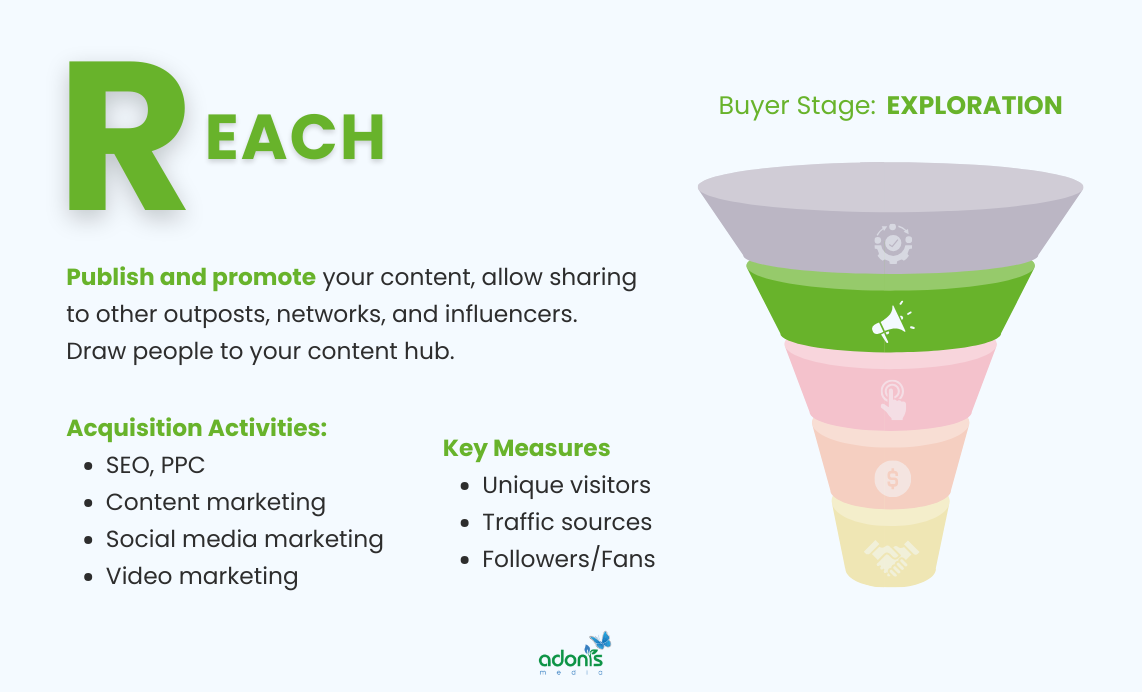
The Reach stage is the first active phase of the RACE framework. It focuses on increasing your brand's visibility and awareness across multiple channels, both online and offline.
 Info came from the RACE Framework graphics of Smart Insights.
The main purpose of the Reach stage is to expand your digital footprint and drive quality traffic to your website or landing pages. This involves building awareness of your brand, products, or services among your target audience in places where they're already active.
At this point, potential customers are exploring options and becoming aware of their problems or needs. They're not necessarily looking for you specifically — yet.
This is the crucial stage where you transform complete strangers into website visitors. Without effective reach strategies, even the best products or services remain invisible in the eyes of those strangers looking for options and answers to their problems.
Key measures or KPIs for the Reach stage include:
- Unique visitors: The number of individual people visiting your website regardless of how many times they visit.
- Traffic sources: Breakdown of where your traffic comes from (organic search, paid ads, social media, referrals, etc.)
- Cost Per Click (CPC): The average amount you pay each time someone clicks on your paid ads.
- Impressions: How many times your content or ads are displayed to users regardless of whether they were clicked.
- Followers/Fans: The number of people following your page/channel like Facebook, X, Instagram, etc.
- Click-Through Rate (CTR): The percentage of those who click on your ads or links after seeing them.
- Cost Per Acquisition (CPA): How much you spend on marketing to acquire one new visitor.
Key customer acquisition activities for the Reach stage:
- Search Engine Optimisation (SEO): Improving your website's visibility in organic search results to capture relevant traffic.
- Pay-Per-Click advertising (PPC): Running targeted ads on search engines and various platforms to drive immediate traffic.
- Content marketing: Creating valuable blog posts, guides, and resources that attract your target audience.
- Social media marketing: Building presence on platforms where your audience spends time and sharing engaging content.
- Influencer partnerships: Collaborating with industry voices that already have the attention of your target audience.
- Video marketing: Creating educational or entertaining videos for platforms like YouTube to increase visibility.
- Podcast advertising or appearances: Reaching audiences through audio content consumption channels.
- Display advertising: Using banner ads on websites to increase brand visibility.
Act
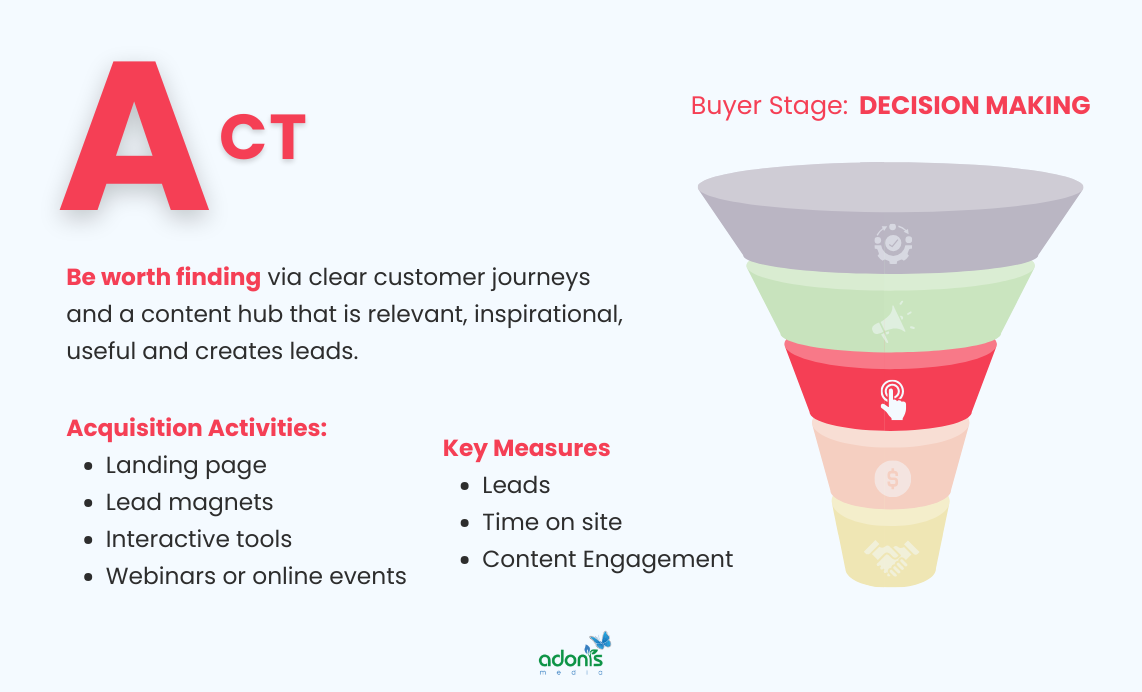
The Act stage is where you encourage first-time visitors to take their next step and interact meaningfully with your brand. It bridges the gap between initial awareness and conversion.
 Info came from the RACE Framework graphics of Smart Insights.
The main purpose of this stage is to generate interest and desire in your offerings by providing value upfront. You're persuading visitors to spend more time engaging with your content and moving closer to a decision rather than bouncing away.
Visitors are now actively considering solutions to their problems or needs and evaluating potential options, including what you offer.
This is the pivotal stage where you transform website visitors into qualified prospects or leads. Without effective "Act" strategies, your hard-earned traffic will come and go without business benefit.
Key measures or KPIs for the Act stage include:
- Bounce rate: The percentage of visitors who leave your site after viewing just one page, with lower rates indicating more engaging content.
- Time on site: How long visitors spend browsing your content, with longer times suggesting stronger engagement and interest.
- Pages per visit: The average number of pages users view during a session.
- Lead conversion rate: The percentage of visitors who take a desired action, like signing up for a newsletter or downloading content.
- Micro-conversions: Smaller commitment actions like watching a video, using a calculator tool, or saving items to a wishlist.
- Blog/content engagement: Metrics like scroll depth, comments, and shares that show how audiences interact with your content.
- Return visitor rate: The percentage of people who come back to your site.
Key customer acquisition activities for the Act stage:
- Landing page: Creating focused, compelling pages designed to convert visitors based on their specific interests or needs.
- Lead magnets: Offering valuable downloadable content like guides, templates, or checklists in exchange for contact information.
- Email capture forms: Strategically placing sign-up opportunities throughout your site with clear value propositions.
- Interactive tools: Providing calculators, quizzes, or configurators that engage visitors while collecting useful data.
- Video demonstrations: Showing your product or service in action to build understanding and confidence.
- Free trials or samples: Letting potential customers experience your offering without full commitment.
- Webinars or online events: Hosting educational sessions that showcase your expertise and allow direct interaction.
- Social proof elements: Displaying testimonials, reviews, and case studies to build trust and credibility.
Convert
The Convert stage is where you transform interested prospects into paying customers. It's the critical point where commercial transactions occur and business value is directly created.
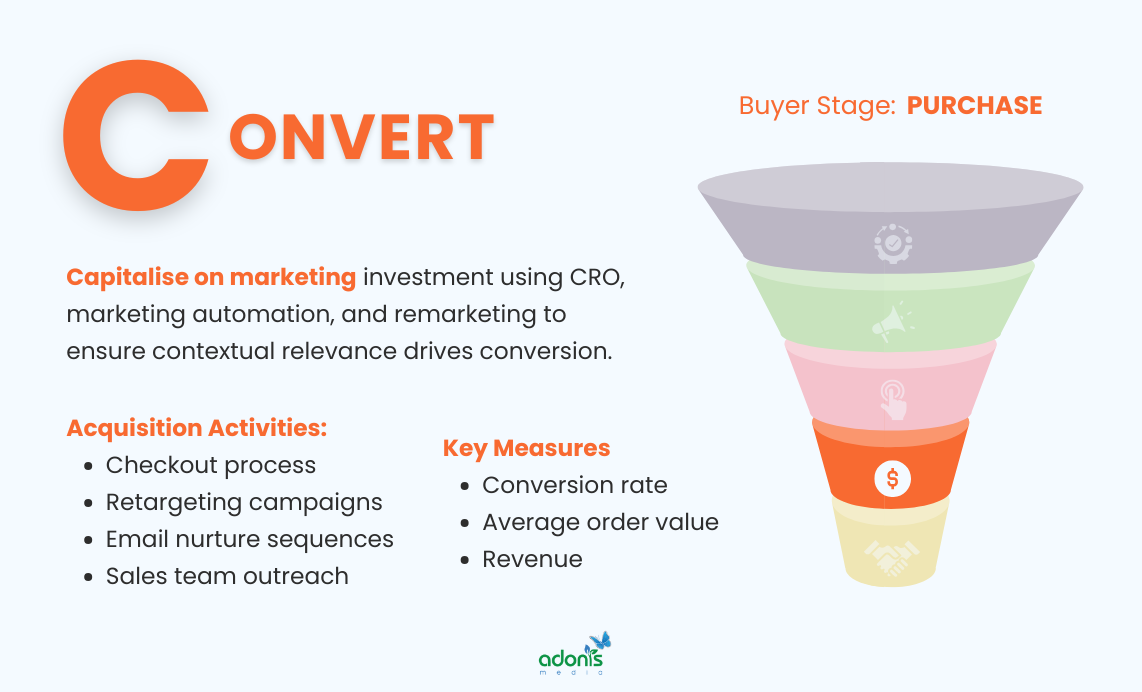 Info came from the RACE Framework graphics of Smart Insights.
The main purpose of this stage is to persuade leads to make that all-important first purchase. Your marketing efforts now focus on reducing friction, addressing objections, and providing the final push needed to secure the sale or conversion.
At this point, prospects have identified your solution as a strong contender and are ready to make a buying decision if you can overcome any final hesitations they might have.
This is the decisive stage where qualified leads finally become customers. Effective conversion strategies need to be implemented to make these leads choose you.
Key measures or KPIs for the Convert stage include:
- Conversion rate: The percentage of total website visitors or leads who complete a purchase or desired conversion action.
- Average order value (AOV): The average amount spent each time a customer places an order.
- Cost per acquisition (CPA): The total cost of acquiring a paying customer across all marketing channels.
- Shopping cart abandonment rate: The percentage of users who add products to their cart but leave without completing the purchase.
- Lead-to-customer conversion rate: The percentage of qualified leads who become paying customers.
- Revenue: Total income generated from conversions, the ultimate measure of this stage's success.
- Conversion by traffic source: Breakdown of which channels deliver the highest-converting visitors.
Key customer acquisition activities for the Convert stage:
- Optimised checkout process: Streamlining the path to purchase by removing unnecessary steps and friction points.
- Retargeting campaigns: Showing personalised ads to people who visited your site but didn't convert, reminding them to return.
- Email nurture sequences: Sending automated, personalised email series to guide leads through final decision-making steps.
- Limited-time offers: Creating urgency through special promotions with clear deadlines to encourage immediate action.
- Customer reviews integration: Displaying social proof at critical decision points to build confidence and overcome objections.
- Abandoned cart recovery: Sending reminders to people who've left items in their shopping cart without completing the purchase.
- Sales team outreach: Direct contact from sales representatives for high-value B2B conversions or complex products.
- Guarantee and return policies: Reducing perceived risk by clearly communicating customer-friendly policies.
Engage
The Engage stage is the final phase of the RACE framework, focused on developing long-term relationships with existing customers after they've made their initial purchase.
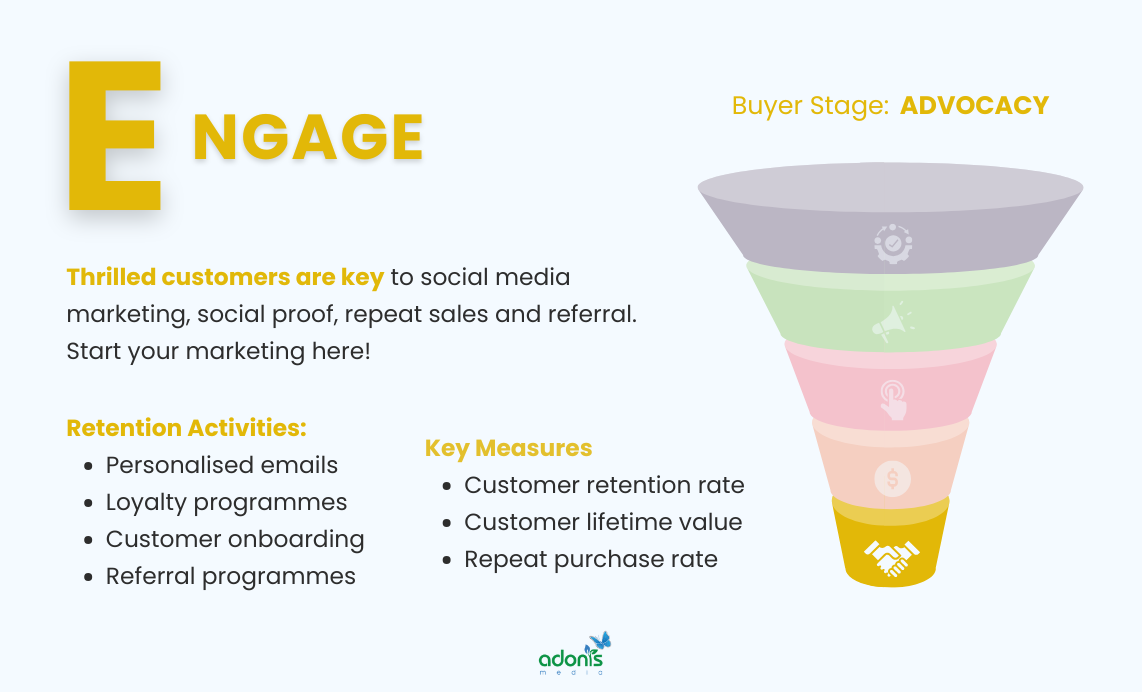 Info came from the RACE Framework graphics of Smart Insights.
The main purpose of this stage is to maximise customer lifetime value by encouraging loyalty, repeat purchases, and advocacy. It's about transforming one-time buyers into brand enthusiasts who keep coming back and bring others with them.
Customers have experienced your product or service and are forming opinions about their overall experience that will determine their future relationship with your brand.
This is the strategic stage where one-time customers become repeat buyers and loyal fans. Without effective engagement strategies, you'll constantly need to acquire new customers rather than benefiting from the more profitable repeat business.
In B2B scenarios, engaged clients become powerful advocates who provide testimonials, case studies, and referrals while maintaining their own relationship with your business. They essentially become part of your marketing team.
Key measures or KPIs for the Engage stage include:
- Customer retention rate: The percentage of customers you retain over a specific period, directly measuring your ability to keep clients satisfied.
- Customer lifetime value (CLV): The overall revenue you can expect from a single customer throughout their relationship with your business.
- Repeat purchase rate: How frequently customers come back to make additional purchases.
- Net Promoter Score (NPS): A measure of how likely customers are to recommend your company to others, scored from -100 to +100.
- Customer satisfaction score (CSAT): Direct feedback from customers rating their satisfaction with your products or services.
- Active subscription renewal rate: For subscription businesses, the percentage of customers who continue their service beyond the initial period.
- Customer engagement score: A composite metric combining various interaction points like email opens, social engagement, and site visits.
Key customer retention activities for the Engage stage:
- Personalised email marketing: Sending tailored content and offers based on previous purchase behaviour and preferences.
- Loyalty programmes: Rewarding repeat purchases through points, tiers, or exclusive benefits that incentivise ongoing engagement.
- Customer onboarding: Helping new customers get maximum value from their purchase through tutorials, guides, and support.
- Post-purchase follow-up: Checking in after delivery to ensure satisfaction and address any issues promptly.
- Exclusive content: Providing special resources, early access, or insider information to existing customers.
- Community building: Creating spaces where customers can connect with each other and your brand, such as forums or user groups.
- Referral programmes: Encouraging satisfied customers to recommend your business to others through incentives.
- Customer feedback loops: Regularly soliciting and acting on customer input to continuously improve your offerings.
- Upselling and cross-selling: Recommending relevant additional products or services based on previous purchases.
RACE Framework Best Practices
This practical framework doesn't end there. It needs practical tips on your execution as well. Ensure you apply all of these tips to ensure your RACE implementation is on the right track.
Set Realistic Timeframes for Each RACE Stage
Don't rush your marketing process. Each stage in the RACE framework needs enough time to work its magic. It's not a sprint.
Setting realistic timeframes helps you measure progress properly and avoid jumping to conclusions too soon. Patience pays off when implementing the RACE model.
Plan your campaigns with buffer periods to accommodate unexpected delays or learning curves. The marketing process rarely goes exactly to plan.
Review your timelines regularly and adjust based on actual performance data to keep your strategy flexible and effective. Your use of the RACE framework should evolve as you learn what works for your specific audience.
Create Seamless Handoffs Between Marketing and Sales Teams
Marketing and sales should be best mates, not strangers passing the baton awkwardly.
Smooth handoffs ensure leads don't fall through the cracks and that messaging stays consistent throughout the customer journey.
Smarketing is the alignment of sales and marketing teams to work towards shared goals, improving communication, and results. It's essential for effective digital marketing planning.
Sales enablement is the act of giving your sales team the tools, content, and information they need to close deals effectively, making handoffs smoother. This bridges the gap between your marketing strategy and actual revenue generation.
Hold regular joint meetings to keep both teams in sync and share insights about customer behaviour and campaign performance. Communication is key.
Create shared KPIs that encourage collaboration rather than competition between marketing and sales. When you use the RACE framework to increase conversions, aligned teams will significantly boost your results.
Identify and Fix Leaks in Your RACE Funnel
Every marketing funnel has weak spots where potential customers drop off. Finding these leaks can dramatically improve your RACE framework results.
Look for sudden drops in your metrics or KPIs between stages. Data tools like Google Analytics are your best friends for spotting these trouble areas in your customer journey.
Once you've found a leak, test different solutions one at a time. Small tweaks often make big differences in how customers move through your marketing process.
Remember that fixing one leak might reveal others that were previously hidden. Focus on the biggest leaks first — the areas with the highest drop-off rates — to get the most immediate return on your effort.
Set up regular funnel analysis sessions with your team to review the entire customer journey from Reach to Engage. Fresh eyes often spot issues that those closest to the work might miss.
Tailor Implementation to Your Business Scale
The RACE model isn't one-size-fits-all. A solo entrepreneur and a multinational corporation will implement it differently, and that's perfectly fine.
Start by honestly assessing your resources, team size, and capabilities. Your implementation should match what you can realistically manage.
Determining whether you're B2B, B2C, or a hybrid is essential during the Plan stage. This fundamentally shapes how you'll approach each subsequent stage of the RACE framework and your overall marketing strategy.
Small businesses might focus on fewer channels, while larger organisations can spread across more touchpoints.
Begin with the stages most critical to your current business challenges. If customer retention is your biggest issue, perhaps start with optimising your Engage stage.
Consider creating a phased rollout plan that lets you implement the RACE framework in manageable chunks rather than all at once. This will help prevent overwhelm while still moving your digital marketing planning forward.
Implement Continuous Testing and Refinement Cycles
Digital marketing planning should include regular experiments to optimise each stage of your customer journey.
Start with A/B testing one element at a time so you can clearly identify what changes affect your results. Too many simultaneous tests make it impossible to know what's working.
The fastest way to improve your RACE model implementation is to embrace what your data tells you, even when it contradicts your assumptions.
Keep a detailed log of all tests, hypotheses, and results to build institutional knowledge about your audience. This documentation becomes increasingly valuable as you use the RACE framework to increase conversions over time.
Further Learning
Looking to learn more? I've collected some fantastic resources that go hand-in-hand with this topic if you want to dive deeper.
- smartinsights.com — Smart Insights Official Website
- smartinsights.com — Introducing The RACE Growth System and RACE Planning Framework: practical tools to improve your digital marketing
- davechaffey.com — Dr. Dave Chaffey Official Website
- davechaffey.com — How do I integrate the SOSTAC® and RACE frameworks?
- sostac.org — SOSTAC® Official Website
- prsmith.org — PR Smith Official Website
- community.hubspot.com — HubSpot Community > Marketing & Content > Marketing Integrations > Race Framework Thread
- reddit.com — Reddit r/marketing Thread: "Any models/framework that help you in your job?"
Bringing It All Together with RACE
The RACE framework transforms the often messy world of digital marketing into a clear, actionable roadmap. From planning your strategy to building awareness, engaging prospects, converting them to customers, and nurturing ongoing relationships, every stage has its purpose and metrics.
By implementing this proven marketing process, you'll stop wasting resources on disconnected tactics and start building a cohesive customer journey that delivers measurable results.
Ready to harness the power of the RACE framework for your business? Book a free consultation with our team today. We'll help you identify quick wins and develop a tailored RACE strategy that turns your marketing challenges into opportunities for growth.
Got a question in mind? Check out the FAQs below for quick answers!
